
From bottling sodas to building stereos, David Black has been blessed with treasured colleagues, unique opportunities and the chance to leave a legacy with a historic video production.
Words by Jamie Sorcher
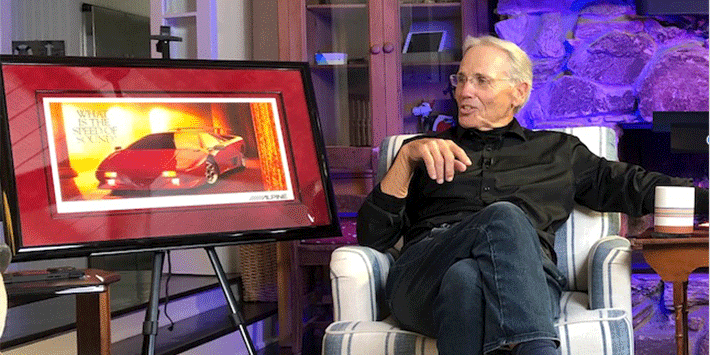
One might think after a dynamic 40-year career and a 2025 Hall of Fame induction, a car audio executive would be ready to shift gears and cruise toward retirement. Not the case with David Black, founder and COO of On-Board Engineering & Sales Inc., who is in final production of a passion project—the historical DocuCast on Alpine Electronics’ introduction to the United States, where he was one of six founding members.
Car stereos were just a hobby in high school during the mid-1960s, according to Black. “The car radio business was just beginning to mature, but I was involved with four-track and eight-track tape players,” he said. “Those weren’t really radios, but under-dash equipment. That was where it all started for me, and my hobby turned into a career that’s lasted four decades.” According to Black, such an outcome had never been his intention.
The Birth of a Brand
In high school, Black’s main focus was football. After an injury dashed his hopes of earning an athletic scholarship and possibly attending Ohio State, Black took a job at the Coca-Cola Bottling Plant in Los Angeles. The next opportunity came with the Japanese company Brother International, known for building printers, label makers and fax machines. When he joined, Black said, it was focused on typewriters and sewing machines. His role was a combination sales and marketing position that provided him with a unique opportunity.
“Brother did something that not a lot of the other typewriter companies were doing back then. They were building Spanish keyboard typewriters,” he said. “With California sharing a border with Mexico, I was up and down and all over Mexico for years, promoting these Spanish keyboard typewriters. We were unbelievably successful.”
The next part of Black’s career was marked by mentors, life-long friends, and what he ultimately calls his co-pilots. After leaving Brother, he aimed to get into car audio—an industry that was booming at the time. “An unusual situation happened next. I was looking for a guy, a rep up in Northern California, to help launch a speaker line. I spent over two hours interviewing this character and at the end of the interview he said to me, ‘You’re not interviewing me. I’m interviewing you. I want you to join me in this company called Alpine Electronics.’”
Black knew nothing of Alpine Electronics, but Reese Haggott pulled out spec sheets of products. The company hadn’t been formally introduced in the U.S. at that point, but the rest, as Black said, is history. “I spent the next 15 years on what is probably the wildest ride I have had in my entire career. I was one of the six U.S.-based founders of Alpine. There are very few car audio companies that I know of that have had the growth, brand positioning, fun and energy that this company had over the course of its first 15 years. That is what our DocuCast is all about.”
Haggott, a well-known leader in the car audio industry, was a visionary. He is credited with helping to transform 12-volt from its low-rent roots to a high-end inclusion in Lamborghinis. From 1978 to 1986, he led Alpine Electronics as SVP, building a nationwide network of Alpine specialty retailers who numbered 600 at the time. He is credited with creating a business distribution model that became the gold standard.
“It was just the two of us at that point,” Black said. “Together, we had plenty of assets from each of our histories, and we spent a substantial amount of time figuring out the right type of team, the best type of sales and distribution policies, and ultimately, how to take Alpine Electronics to the U.S. and be successful. There was product, but no brand. In 1978, the decision to make the brand happen took place in a little hotel, the Captain Cook, in Anchorage, Alaska, because it was the center point to fly in for both the U.S. and Japanese teams. That is where the brand was born—right there.”
Lesson #1: Failure is a Better Teacher Than Success
Many colleagues with whom Black and Haggott were located in California, and already reasonably successful in car audio. One of them was Harry Brix, the owner of Pana-Pacific based in Campbell, Calif. Black said he and Brix had worked together in the past. “It was one of those relationships where you didn’t have to work that hard at it,” he said. “Harry was successful in the category, with retail and redistribution, and he was an invaluable mentor of mine.” Brix assisted with product design, sales and distribution for high-end product, he added, noting that he and Haggott “mentored with him for quite some time before we put together the infrastructure at Alpine, and then introduced it to the U.S.”
Brix had a casual approach, Black said, and always seemed in a great mood no matter what was happening. “He led with a big heart, but an iron fist. Without question, he was one of the most balanced human beings I have ever known, especially for someone leading a company that was valued at $200 million.”
He was humble, yet tough: “His company probably had in excess of 300 employees at one time. As Harry told me, he could buy anything he wanted—houses, automobiles, whatever. But he drove a regular old van to work every day. He never put a reserved parking spot in the lot for anyone, not even himself. Whoever got to the lot first in the morning had their choice of parking.”
From Brix, Black learned about the importance of taking risks. “He is the first guy I ever had a chance to work with who believed that failure is part of life. That’s how you learn to make things happen, when you make mistakes. It’s nothing to fear. We made some big mistakes at Alpine—which we talk about in the DocuCast—but I learned more from those kinds of experiences than I ever did from winning, and it has made me a better executive.”
Along with that, Black said, it’s critical to have management who supports you. “When you make those mistakes, you want the kind of boss who has your back and doesn’t turn into some Godzilla because of what you’ve done. If the management team is sensitive and understanding, they will come down with the proper stewardship and guidance to turn you into an ace.”
Also from Brix, Black learned to look at the big picture and avoid getting caught up in the details. “Harry wasn’t worried about minutiae,” he said. “He just wanted the big things done correctly.”

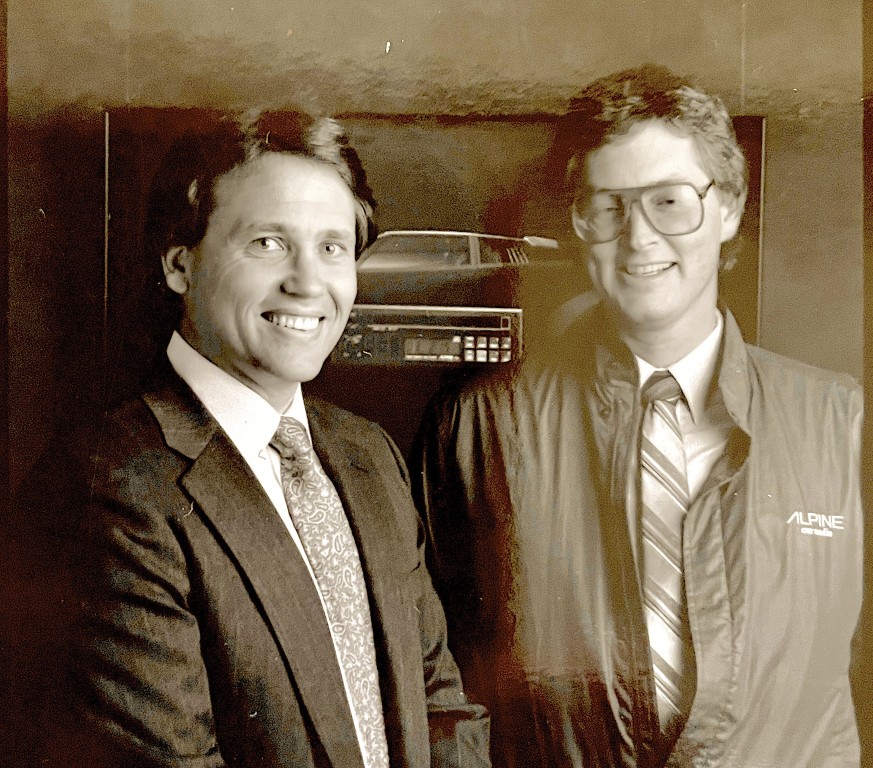
Dave Black and Rich Coe worked together at Alpine, then continued their collaboration through On-Board Engineering & Sales, Inc.
Lesson #2: Understand the Culture of the Marketplace
As Black built Alpine, one of the most demanding yet rewarding opportunities was establishing relationships with Japanese executives. Black considers Seizo Ishiguro a mentor—the President of Alpine Electronics of America. “He was relatively young, too, and was selected to handle the branding and introduction of Alpine worldwide, but he started the process in the U.S.”
Alpine of Japan, Black said, had a unique approach to global marketing. The company was interested in local markets, but it had more of a global perspective. At the time, he added, the U.S. was influencing the rest of the world through its music, videos and films. Therefore, anything that happened in America would likely happen elsewhere.
“That stuck with me the entire time at Alpine. When we did something—whether it was launching a new product or implementing a new marketing program, developing a new category—we did it here in the States first. We tested it, then ran to Japan with 15 other nations and explained to them in detail what the U.S. was doing.”
Then, he said, those countries went back to their local markets and implemented whatever had been successful in the U.S. “It made Alpine a global hotshot. For every quarter from 1980 to 1994, I was in Japan four times a year for what they called a marketing corporate identity meeting. That’s where I met with those 15 other countries and kept explaining what we were doing. They all followed based on Seizo’s guidance.”
From Ishiguro, Black learned that being bilingual wasn’t important. What is critical, he said, is being bi-cultural.
“If you don’t understand the culture of the marketplace in which you’re trying to sell, you lose. But if you are culture-sensitive, and you make sure everything you’re doing culturally is lining up with the folks in those markets, then the chance for success is greatly improved. That’s something many people never understood.”
Instead, he said, they’d try to figure out the language “when it had nothing to do with launching the products successfully.” It’s the cultural connection, he said. “That’s the most important part—and it still is today.”

COMING SOON:
THE ALPINE TOUCH
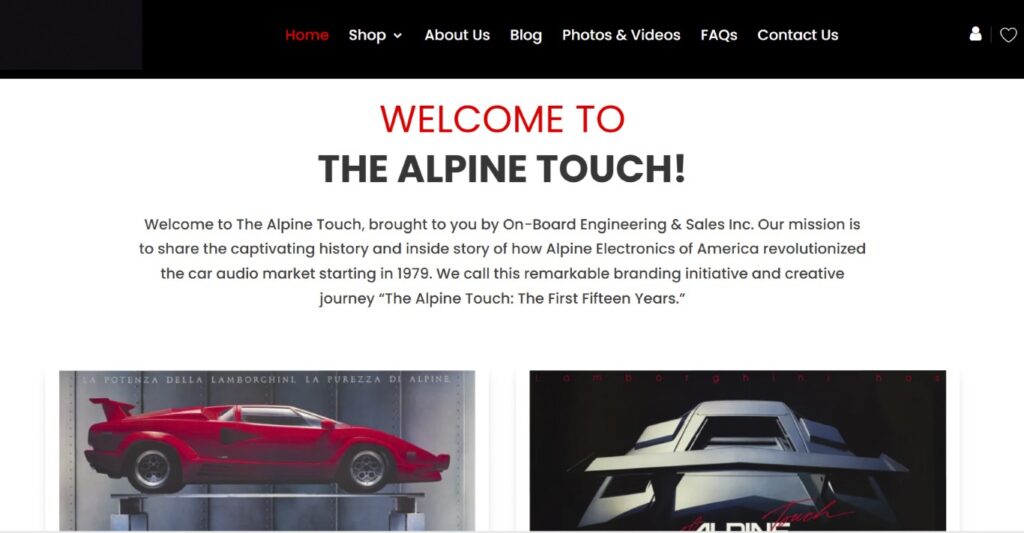
The DocuCast—brought to viewers by On-Board Engineering & Sales, Inc.—is called “The Alpine Touch: First 15 Years.” It will begin airing around Thanksgiving. The mission is to share “the captivating history and inside story of how Alpine Electronics of America revolutionized the car audio market starting in 1979,” according to the website. For more information, and for details on a Collector’s Set of images from over the years, please visit www.thealpinetouch.com.
Lesson #3: Cultivate a Strong Support System
Jim Minarik, the CEO at Clarion from 1992 to 2000, convinced Black to make a move and join the team at Clarion. “Jim was in the process of working this AutoPC situation and I knew at that point in time where Alpine was headed—and nothing like that was on the horizon,” Black recalled, adding that although his main focus was marketing and sales, he was technical, too. “I saw things Jim was trying to do at Clarion, and felt convinced he was going down the right road.”
Black also felt concerned that his own company hadn’t yet considered the kinds of things Clarion was working on. “It seemed like they were setting up a whole new world order,” he said. “The San Jose people and all the software folks were headed to the automotive industry. And Clarion, through Jim, accelerated that situation.”
Black had an interesting ride at Clarion. First, the company had a slightly different approach to the marketplace than Alpine, and had a group specifically dedicated to marine. That intrigued Black, but first he was asked to head up a subsidiary of Clarion, called McIntosh Labs in Binghamton, New York.
“I was sitting at a bar in Tokyo, and I got a call from Jim. He told me I was going to run McIntosh until a new president for that company was found. For the short time I was there, just under two years, it’s probably one of the most fun experiences I ever had.”
Black remained a loyal co-pilot of Jim’s for almost everything he did. “I rejoined Clarion 16 months later and believed that marine audio was going to have a metamorphosis. You need waterproof stuff on a boat. You can’t use regular aftermarket radios. First time they’re hit with salt or fog, they just blow up. So, I set out on a mission to be the leanest and meanest waterproof guy you’ve ever seen in your life, building platforms that were virtual submarines.”
Clarion started to wind down the marine part of their business because they were suffering the slow but certain reduction in sales of head units, according to Black. Soon, he was ready to make another move, and shifted to his own company in 2004—On Board Engineering & Sales.
He ran the new company with Rich Coe and the two focused on marine audio. Coe was involved on the engineering side, Black said. He’d been Black’s “right hand” the entire time he’d been at Alpine, and remained a cherished friend. “Our families have known each other for years. We’ve probably gone fishing together more days than we worked. He comes with a long list of credentials and he’s humble.”
Also, Coe often told jokes and played pranks. “He’s extraordinary. He was an entertainer at one point in his career so he was comfortable getting up in front of people and speaking and telling stories. He just understood audiences. When we had dealer conferences, which sometimes involved 1,000 people, the audience would laugh, cry and they were ready to write orders. I still see him every week.”

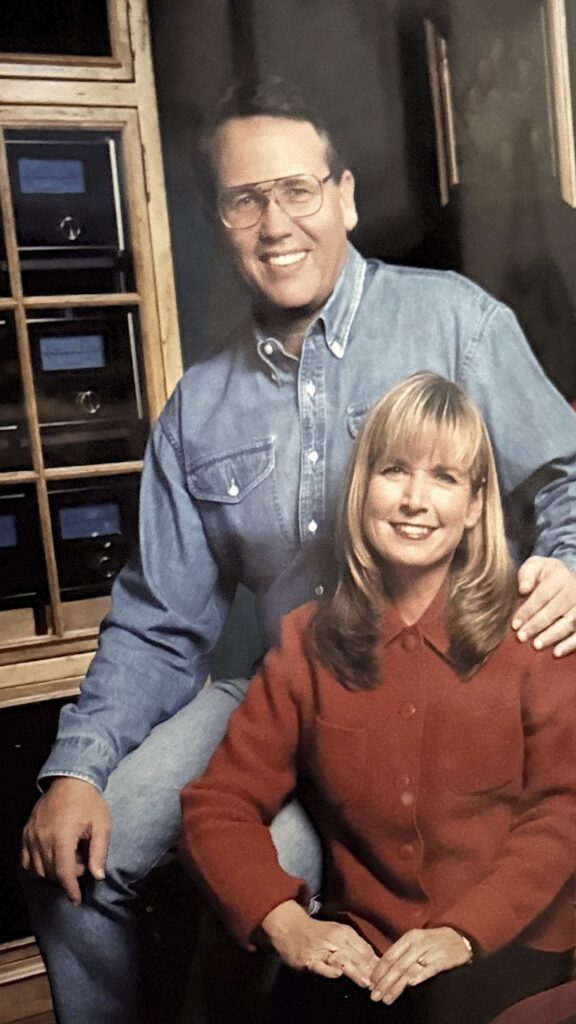
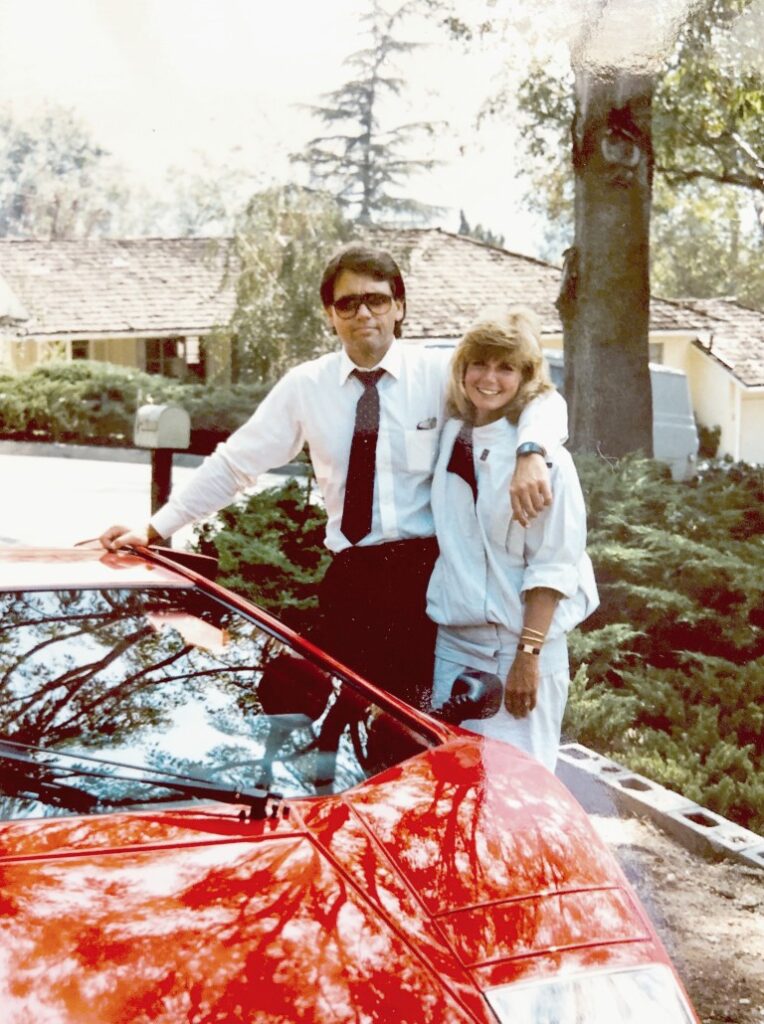
Black credits his wife, Jan, for being his greatest source of support. The two first met in high school.
The strongest part of his support system, Black said, is his wife Jan—his high school sweetheart. “I was on airplanes and in hotels six months out of the year,” he said, noting that he never could’ve pulled it off without her support.
The thread running through everything, he added, is passion. “Harry Brix, Seizo Ishiguro, Jim Minarik, and Rich Coe—all of them have passion. If you can find a way to identify people like this in your career, you want them along for the ride. Throw a hook in the water and see if you can link up with the kind of colleagues who will be your lifelong friends. I did it primarily by luck,” he said, adding, “If you can pull it off, then do it.”